

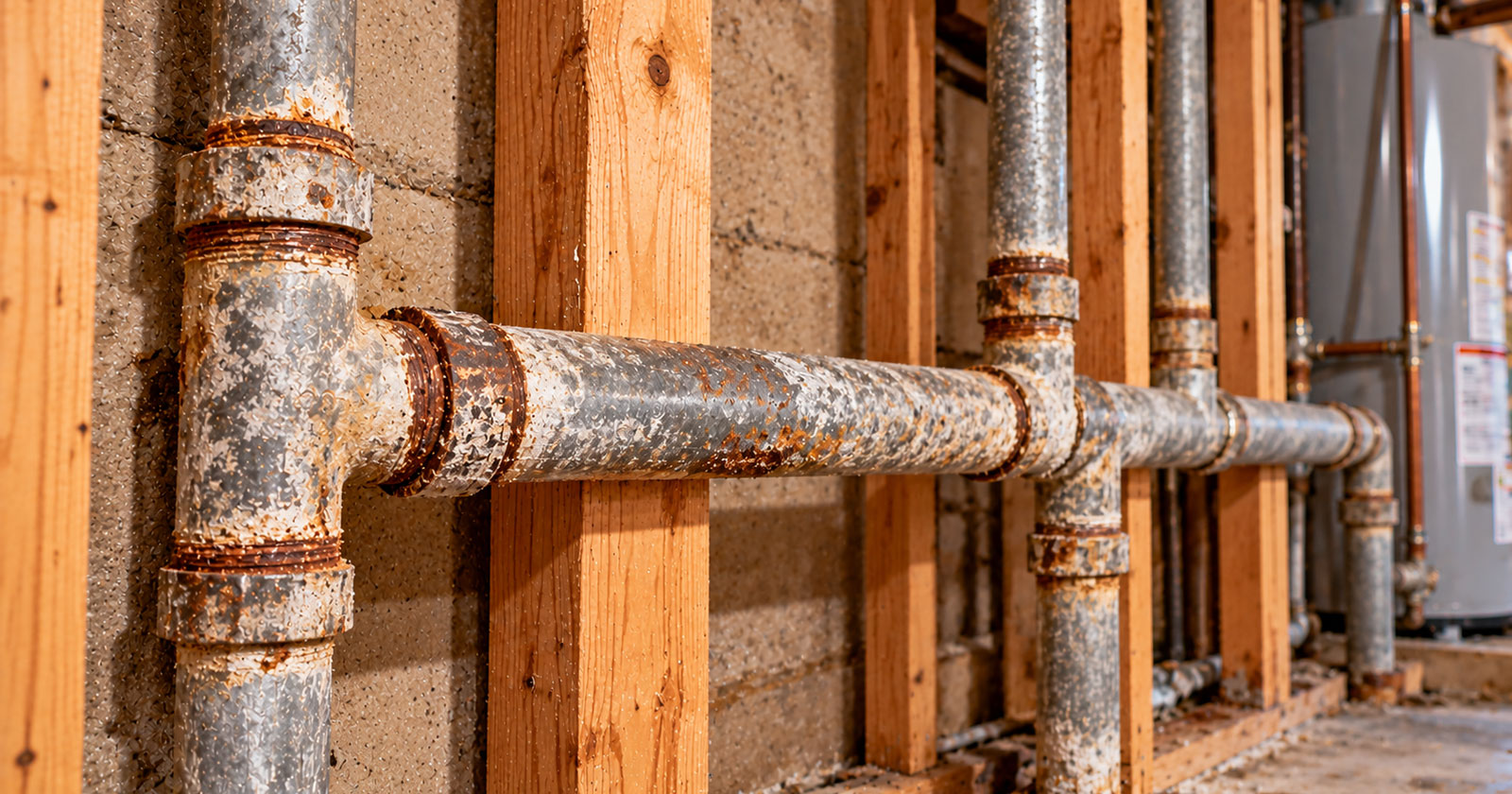
Galvanized pipe replacement makes sense once the pipe starts showing its age: low pressure when two fixtures run, rusty water first thing in the morning, or leaks in more than one spot. Galvanized steel was commonly used for water lines before the 1960s, so a lot of older LA County homes still have it, and after 60 years or more most of it is closing up from the inside.
The call usually sounds like this. The shower turns to a trickle when someone runs the kitchen sink. The first glass of water in the morning looks like weak tea. And the homeowner has already replaced a faucet or two, hoping that was the problem.
It usually isn’t the faucet.
Why Galvanized Pipe Closes Up Inside
Galvanized pipe is steel or iron dipped in a zinc coating. The zinc wears away first, protecting the steel underneath. Once it’s gone, the steel starts to rust. East Bay MUD’s water quality page explains that the rust doesn’t build up evenly. It forms lumps inside the pipe that grow until they block the flow, which is why old galvanized pipe causes low pressure and discolored water.
That’s the part people don’t expect. The outside of the pipe can look fine while the inside has narrowed to a fraction of its size. Small lines going to a single fixture close up first, and the pipe tends to fail at the threaded joints, where the wall is thinnest.
Signs You Need to Repipe
These are the signs we see in almost every galvanized house our repiping service works on.
- Low pressure that gets worse when two things run. The shower drops when the toilet refills or the washer starts. Pressure that’s low everywhere has other causes too, covered in our whole-house low pressure guide.
- Rusty or brown water, especially in the morning or after a trip, when water has sat in the pipe.
- Leaks in more than one place, often at threaded joints or where the pipe goes through a wall.
- Faucets and valves that clog with flakes. Rust breaks loose and catches in aerators and shower valves.
- A hot side that’s worse than the cold side. Hot water speeds up corrosion, so the hot lines usually go first.
One sign by itself can have another cause. Two or three together in a house built before the 1960s almost always point to the pipe.
How to Tell if You Have Galvanized Pipe
You can usually tell in five minutes. Look where the water line comes into the house, under the kitchen sink, at the water heater, or in the crawl space. Galvanized pipe is dull gray, joined with threaded fittings, and a magnet sticks to it. Copper is orange-brown or dark brown, plastic is white, gray or a bright color, and a magnet won’t stick to either.
Many older houses are a mix. A previous owner may have replaced the line to one bathroom in copper and left the rest. A gray pipe at the water heater doesn’t tell you what’s inside the walls, so check a few spots.
Look at the pipe where it comes out of the ground and into the house. If that’s still galvanized, the line from the meter probably is too, and it belongs on the repipe quote even though it’s outside.
Is Galvanized Pipe a Lead Risk in LA?
For most LA homes, the bigger problem is rust and pressure, not lead. The lead concern with galvanized pipe is that it can collect lead from an older lead service line upstream. LADWP reports that its service line inventory found no lead service lines and no galvanized lines requiring replacement in its system, including customer-owned lines.
That inventory covers the line from the street, not the pipes inside your house, and other cities’ utilities keep their own records. If you’re worried, a certified lab can test your water. And since a full repipe removes the galvanized pipe entirely, it settles the question either way.
Galvanized Pipe Replacement Options
A partial repipe replaces the worst section, and a whole-house repipe replaces all of it. The right call depends on how much galvanized is left, how many leaks you’ve had and how long you plan to stay.
| Option | What it fixes | When it makes sense |
|---|---|---|
| Spot repair | One leaking joint or section | A single leak in a house you’re selling soon |
| Partial repipe | One bathroom, the kitchen, or the main line from the meter | Most of the house is already copper or PEX and one stretch is still galvanized |
| Whole-house repipe | Every supply line, new copper or PEX throughout | Mostly galvanized, low pressure everywhere, more than one leak |
But patching galvanized one leak at a time gets expensive. Every joint is the same age, and fixing one often disturbs the next. Where new pipe meets old steel, the connection needs the right transition fitting, or the joint itself starts to corrode.
How a Repipe Works in an Older House
A whole-house repipe on most single-family homes takes one to two days. We run new copper or PEX lines through the attic, the crawl space or the walls, connect each fixture, then pressure-test everything before the water goes back on for good. Expect the water to be off for stretches while lines are switched over, and we’ll tell you the plan for each day before we start.
Older houses take some care. In Glendale’s 1920s to 1950s neighborhoods and the older blocks of Alhambra, a lot of homes have original plaster, tile and built-ins worth keeping. We route new lines around them wherever the house allows and open small, neat access holes instead of whole walls. Most LA County cities require a permit for a repipe, and we pull it when the job needs one.
So the choice of copper or PEX comes down to the house, the budget and how the lines need to run. We quote both, with a flat-rate price before any work starts.
When to Call a Plumber
Call when the pressure drop is getting worse, when you’ve had a second leak, or when rusty water shows up from the cold tap too. A leak in a galvanized line won’t fix itself, and the next one is usually close by. Hard Hat Rooter and Plumbing repipes older homes across Los Angeles County with a one-year warranty on parts and labor. Call (855) 331-7788 any time, and check our current coupons first.


