

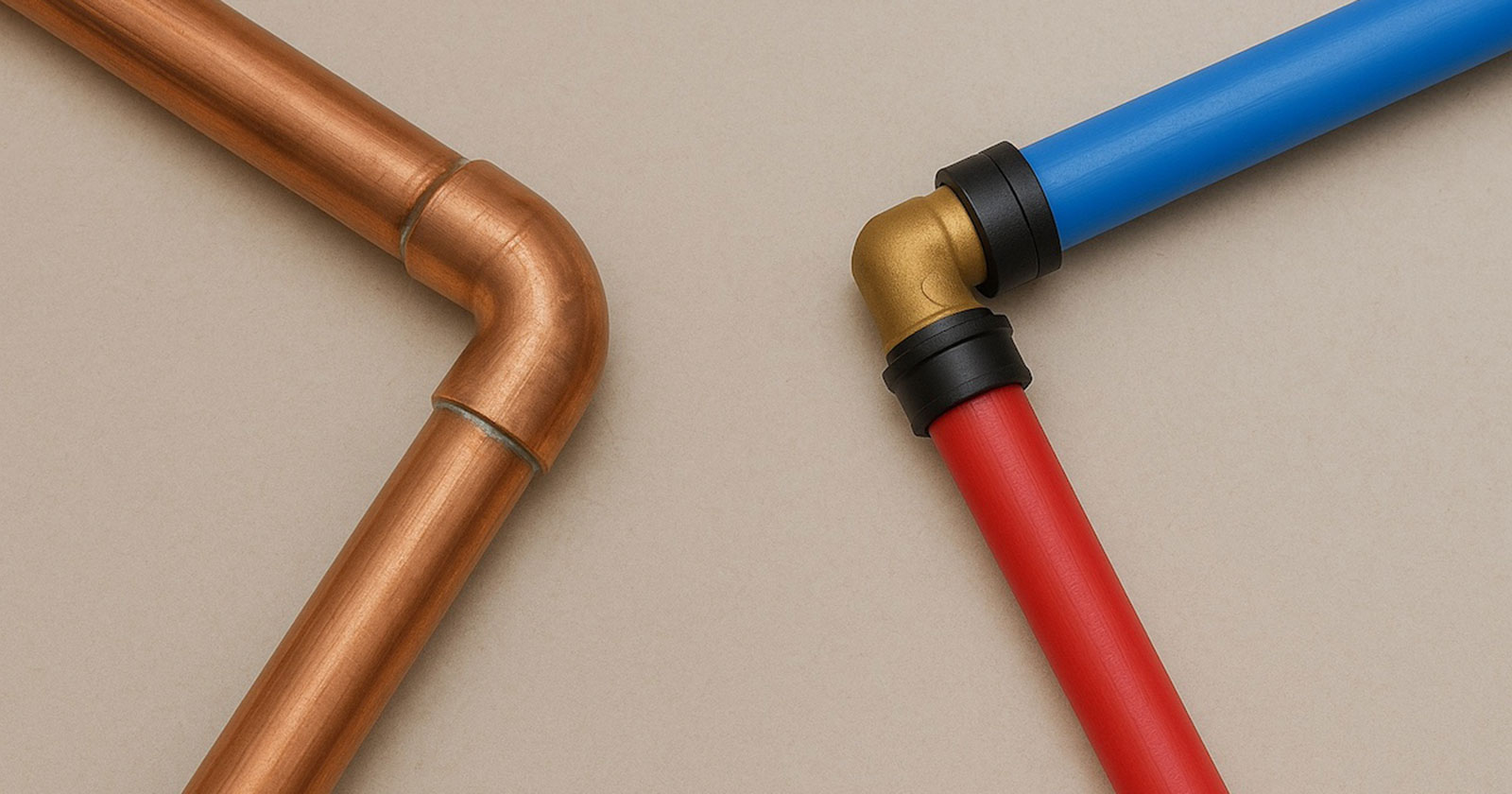
In a copper vs PEX repipe, both materials are approved in California and both will give an LA home decades of good water pressure. PEX usually costs less and goes in with fewer holes in the walls, which matters in an older plaster house. Copper costs more, handles sunlight and exposed runs better, and is what many buyers expect. PEX has been part of the California Plumbing Code since the state adopted it in 2009.
The question usually comes up right after we’ve confirmed the galvanized pipe has to go. The homeowner has heard that copper is the gold standard, and also heard that everyone uses PEX now. Both are true, and neither one settles it.
Here’s how we’d actually decide.
What Copper and PEX Are
Copper is rigid metal pipe joined with soldered or pressed fittings. It’s been the standard for water lines in American homes for generations, and you’ll still find copper from the 1960s working fine in plenty of LA houses.
PEX is cross-linked polyethylene, a flexible plastic tube joined with crimp or expansion fittings. It comes in long coils, so a single run can snake from a manifold to a fixture with no joints in the wall. It’s color-coded red and blue for hot and cold, though the color doesn’t change how it performs.
Both carry drinking water safely when they’re installed to code. The differences are in cost, how they go into the house and where they hold up best. Our whole-house repiping service installs both, so we don’t have a reason to push one.
Copper vs PEX Repipe Side by Side
| Copper | PEX | |
|---|---|---|
| Cost | Higher for material and labor | Usually lower |
| Installation | Rigid, more fittings, more wall openings | Flexible, fewer fittings, fewer openings |
| Older plaster walls | More patching | Easier to fish through existing cavities |
| Sunlight and exposed runs | Fine | Must be protected from UV |
| Joints in the wall | Many | Few or none with home runs |
| California code | Allowed | Allowed since 2009 |
| Buyer perception | Seen as premium | Widely accepted, less familiar to some buyers |
Where PEX Makes the Most Sense
PEX makes the most sense in older houses where opening walls is expensive. A Craftsman in Pasadena or a 1920s bungalow in Culver City often has original plaster, tile and built-ins. Because PEX bends, we can route it through the attic or crawl space and drop it into a wall through a small opening, instead of cutting a path for every rigid elbow.
Fewer openings means less patching and painting after the plumbing is done. And fewer fittings means fewer joints that could ever leak, especially with home runs, where each fixture gets its own line from a central manifold.
So for most budget-conscious whole-house repipes in older homes, PEX is where we’d start the conversation.
Ask whether the quote for PEX includes a manifold with a shutoff for each fixture. It costs a little more, but it lets you shut off one bathroom without turning off the whole house.
Where Copper Makes the Most Sense
Copper makes the most sense where pipe will be exposed or where the owner wants metal throughout. PEX can’t sit in sunlight. The National Association of Home Builders and the Plastics Pipe Institute warn that UV light can degrade PEX over time, so it has to be covered or kept out of the sun. Copper doesn’t care about sunlight, which makes it the easier pick for runs along an exterior wall, in an open garage or anywhere that can’t be covered.
Some owners also choose copper for resale. In higher-end homes, a buyer’s inspector may note copper as an upgrade, and some buyers simply trust it more. That’s a preference, not a performance difference, but it’s a real one.
Many repipes end up as a mix. PEX for the long runs inside, copper where it’s exposed or connects to the water heater.
What Drives the Cost Either Way
The material is only part of the price. What drives a repipe quote in LA County is the house itself.
- Size and fixture count. More bathrooms and more fixtures mean more lines.
- Access. A raised house with a crawl space is easier to repipe than a slab house, where lines often go through the attic.
- Wall finishes. Plaster, tile and custom cabinetry take more care than drywall.
- The line from the meter. If it’s still galvanized, it should be part of the job.
- Permits and patching. Most LA County cities require a permit for a repipe, and wall repair after the work is a separate line on some quotes.
It depends on all five, which is why we quote after we see the house. We price both materials side by side, flat-rate, so you can compare the real numbers for your home instead of averages.
Questions to Ask on Any Repipe Quote
Two quotes for the same house can look far apart because they cover different work. Before you compare prices, ask each plumber the same questions.
- Does it include the line from the meter to the house? If that line is galvanized, leaving it in place keeps part of the problem.
- Is wall patching included, or only the plumbing? Some quotes stop at the hole.
- Who pulls the permit, and is the fee in the price?
- For copper, which type? Type L has a thicker wall than Type M and costs more. A thinner wall has less metal to lose to pinhole leaks in copper.
- For PEX, which brand and fitting system? A known brand with parts at local supply houses makes future repairs simple.
How We’d Choose for Your House
For most older LA homes with plaster walls and a tight budget, we’d recommend PEX with copper at exposed spots. For a house where the pipe will be visible, where the owner wants metal, or where resale to a high-end buyer is the plan, copper is worth the extra cost.
But either one solves the problem you called about. The pressure comes back and the rusty water stops the day the old galvanized pipe is out.
If you’re weighing a repipe, Hard Hat Rooter and Plumbing will walk the house, check the pressure and quote both materials with a one-year warranty on parts and labor. Call (855) 331-7788, and check our current coupons first.


