
Choosing between a tankless vs tank water heater for an LA home comes down to how much hot water you use at once, what your gas line can supply and your budget. Tankless never runs out, but it often needs a bigger gas line. Rinnai’s own technical bulletin says its units typically require a 3/4-inch gas line, and many older LA homes have a 1/2-inch line at the water heater.
The question usually comes up when the old tank is leaking and someone has already told the homeowner that tankless is the way to go. Sometimes it is. Sometimes the upgrade costs nobody mentioned make a new tank the smarter buy.
Here’s how to tell which one fits your house.
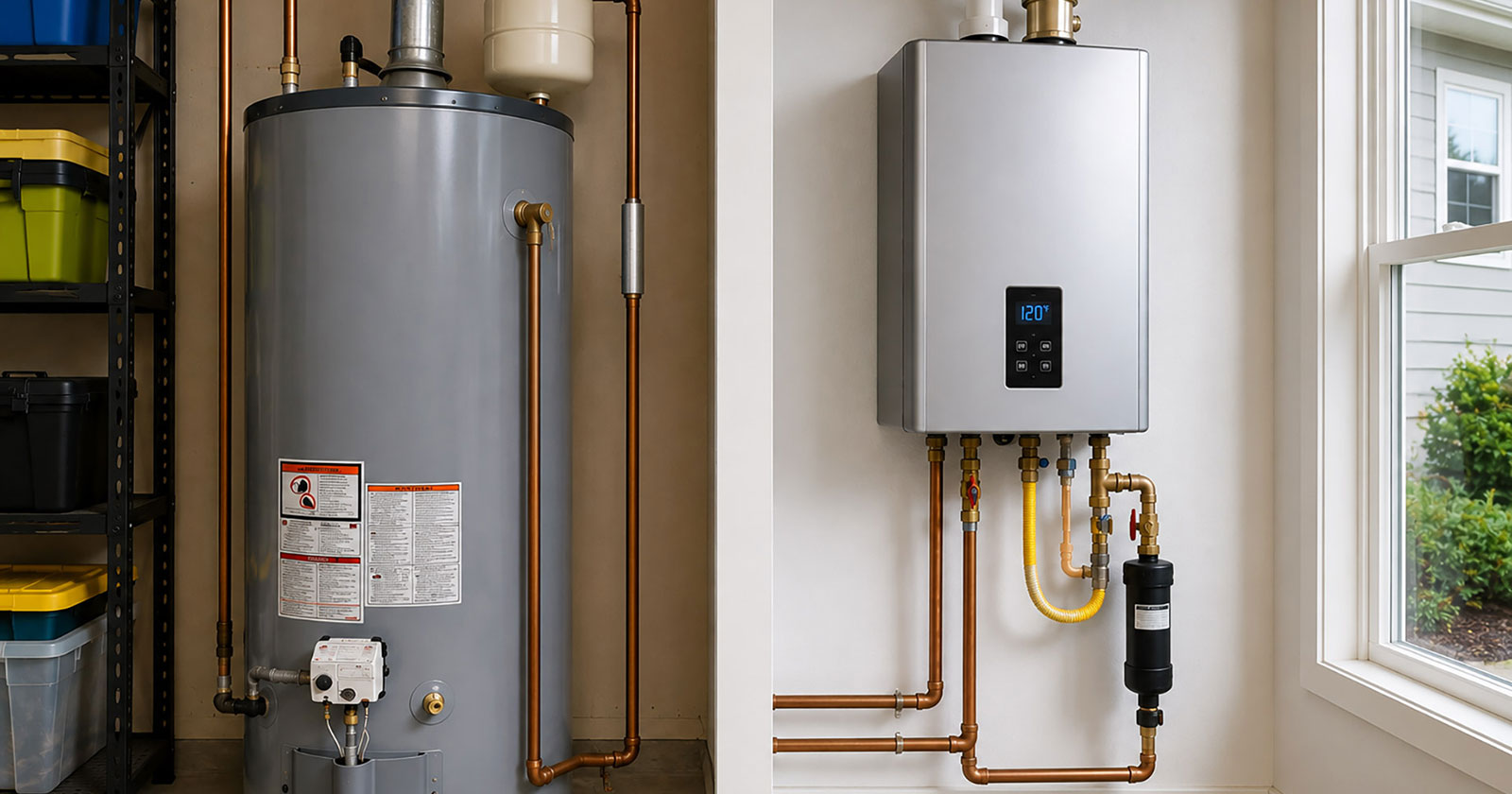
How Each Type Heats Water
A tank water heater keeps 40 or 50 gallons hot all day, reheating it as it cools. When you use hot water, cold water refills the tank and the burner fires. Run enough showers back to back and the tank runs out until it recovers.
A tankless unit holds almost no water. When you open a hot tap, water flows through a heat exchanger and a large burner heats it on the spot. ENERGY STAR explains that tankless models heat water only when it’s needed and provide continuous hot water, and that they’re rated by gallons per minute instead of tank size. The more fixtures you run at once, the more gallons per minute you need.
So a tank’s limit is how much hot water is stored. A tankless unit’s limit is how much it can heat at the same moment. Our water heater service installs and maintains both.
Tankless vs Tank Water Heater Side by Side
| Tank | Tankless | |
|---|---|---|
| Upfront cost | Lower | Higher, especially with gas line or venting upgrades |
| Hot water supply | Can run out, then recovers | Continuous, up to its flow rating |
| Energy use | Keeps a tank hot around the clock | Burns gas only when hot water is running |
| Space | Takes a closet or a garage corner | Mounts on a wall, inside or out |
| Gas line | Usually works with the existing line | Often needs a larger line |
| Maintenance | Flush sediment | Descale the heat exchanger |
| Replacement day | Usually a same-day swap | Same day if gas and venting are ready, longer if not |
The Upgrade Costs Nobody Mentions
The price of a tankless unit is only part of the job in an older house. Three things can add to it.
- The gas line. A tankless burner is much bigger than a tank’s, so it needs more gas. Rinnai’s bulletin says a 1/2-inch line works only in some cases, when pressure is good and the run is short. Otherwise a new, larger line goes back toward the meter, and sometimes the gas meter itself needs to be upgraded by the utility.
- Venting. A tankless unit usually can’t use the old tank’s flue. It needs its own vent, run to the outside.
- Water and power at the new spot. If the unit moves to an outside wall, the water lines and an electrical outlet move with it.
None of that is a reason to skip tankless. It’s a reason to get the full price before you decide. A gas line upgrade is licensed work and needs a permit in most LA County cities.
Before you get a tankless quote, look at the gas pipe where it connects to your current water heater. If it’s thin and the meter is at the far end of the house, ask every installer whether their price includes a new gas line.
Hard Water and Tankless Heaters
Hard water is the main maintenance issue for a tankless unit in Los Angeles County. Minerals in the water form scale inside the narrow heat exchanger, and scale cuts flow and efficiency. Tanks get scale too, but it settles to the bottom as sediment instead of clogging small passages.
LA’s water is hard in a lot of places. In LADWP’s 2025 water quality report, water from the LA Aqueduct averaged 103 milligrams per liter of hardness, while water from Metropolitan Water District’s Weymouth plant averaged 234. Depending on which source feeds your neighborhood, your water can be more than twice as hard as the Aqueduct supply. Foothill areas like La Crescenta and the Santa Clarita Valley are hard on heaters of both kinds.
That doesn’t rule tankless out. It means descaling is part of owning one. How often depends on your water and how much hot water you use, and we’ll set a schedule after we test it.
When a Tank Is the Smarter Buy
A tank is the smarter buy when the gas line or venting would need major work, when the budget is tight, or when the old tank failed and you need hot water today. We finish most tank swaps the same day.
A tank also makes sense for a small household that rarely runs two showers at once. The savings from tankless are smaller when you use less hot water, and the higher upfront cost takes longer to pay back. If you want to know how much life a tank has left, our guide to how long a water heater lasts in LA hard water covers it.
When Tankless Is Worth It
Tankless pays off for a busy household that runs out of hot water, for a home that needs the closet or garage space, and for owners staying long enough to collect the savings. It’s also the easier call when the gas line is already large enough, or when you’re remodeling and the walls are open anyway.
But size it right. A unit that’s too small for three people showering in the morning will disappoint, and that’s the most common complaint we hear about tankless. It depends on your peak demand, not your average.
Check for rebates too. ENERGY STAR’s rebate finder and SoCalGas list current offers on certified units, and they change often, so look before you buy.
Getting a Straight Answer
Hard Hat Rooter and Plumbing installs and services both, so we’ll tell you which one fits your house and your gas line. You get a flat-rate price for each option, including any gas line or venting work, before anything starts. Call (855) 331-7788 any time, and check our current coupons first.