
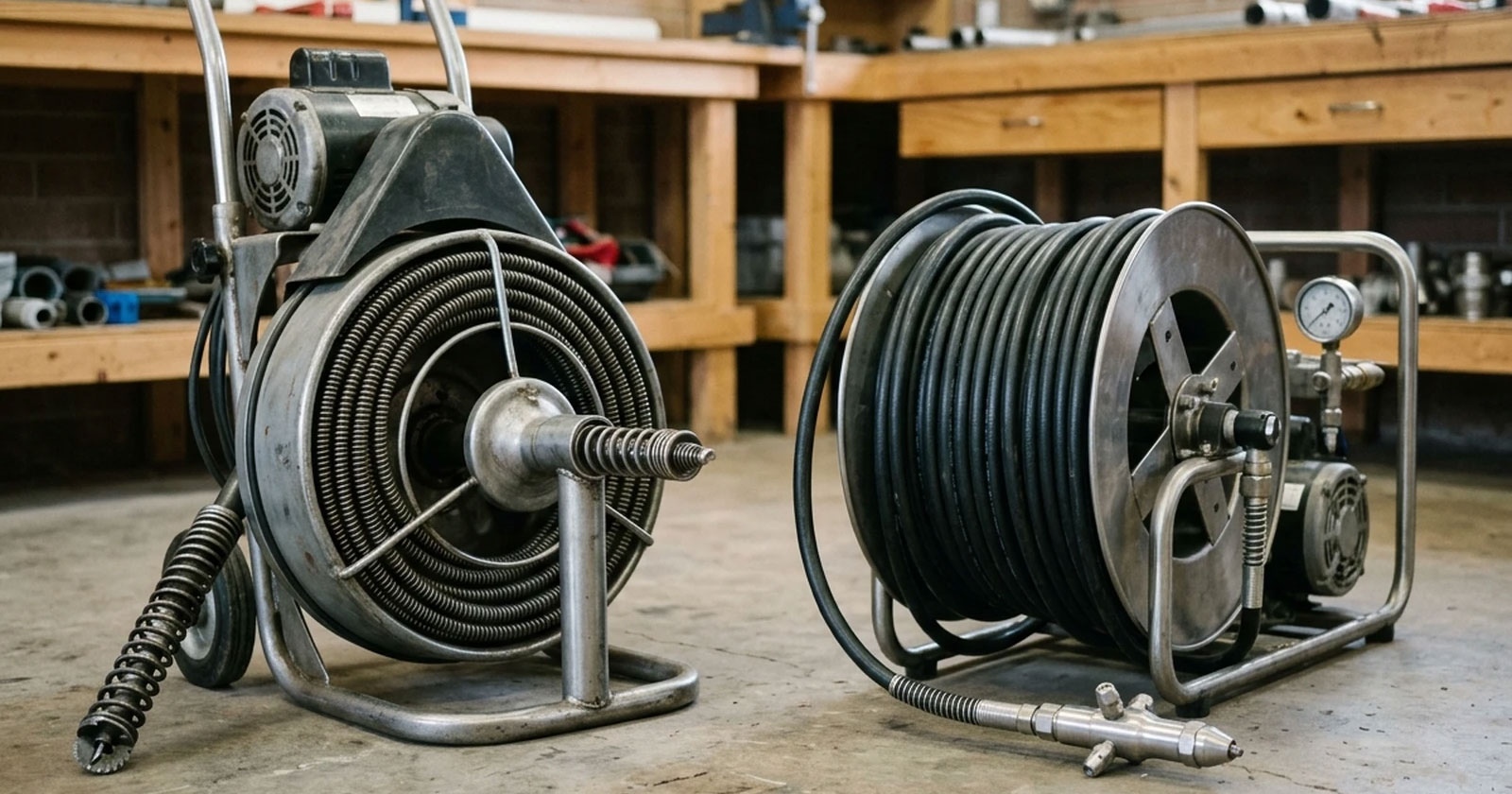
In the hydro jetting vs snaking choice, a snake is the right tool for one clogged fixture, and a hydro jetter is the right tool for a line that keeps clogging from grease, roots or scale. That difference matters in Los Angeles, where LA Sanitation says over 50% of sewer backups are caused by tree roots and poured fats, oils and grease. Those are the two things a cable punches through but leaves behind.
A call we get a lot goes like this. The kitchen sink was snaked in the spring. It drained fine for a few months. Now it’s slow again, and the homeowner wants to know whether to snake it again or pay for the jetter they’ve heard about.
Fair question.
The honest answer starts with what each machine actually does inside the pipe.
How a Snake and a Jetter Work
A snake, also called a cable machine or auger, is a steel cable that spins as it’s fed into the drain. A cutting head on the end bores through the blockage so water can flow again. It opens a path. It doesn’t scrub the pipe.
A hydro jetter feeds a hose down the line with a nozzle that sprays high-pressure water forward into the blockage and backward against the pipe wall. The backward jets pull the hose along and scour the inside of the pipe as it travels. Grease, sludge, scale and fine root hair get flushed downstream to the city main.
So a snake treats the clog and a jetter treats the pipe. Hard Hat Rooter and Plumbing carries both on the truck, and our drain cleaning and hydro jetting service uses whichever one the line actually needs.
Hydro Jetting vs Snaking Side by Side
Here’s how the two compare on the drain jobs we see most in LA County homes.
| Snaking | Hydro jetting | |
|---|---|---|
| What it does | Bores a path through the clog | Scours the full inside of the pipe |
| Best for | One slow sink, tub, shower or toilet; hair, paper or a dropped object | Grease in kitchen lines, roots, scale in cast iron, lines that clog again and again |
| What it leaves behind | Grease and root hair still on the pipe wall | Very little, if the pipe is sound |
| How long the fix lasts | Often weeks or months on a grease or root problem | Longer, because the buildup is gone |
| Cost | Lower | Higher, with more equipment and time |
| Risk to old pipe | Low, though a cutter can catch on a broken joint | Needs a sound pipe, so a camera should come first |
When Snaking Is the Right Call
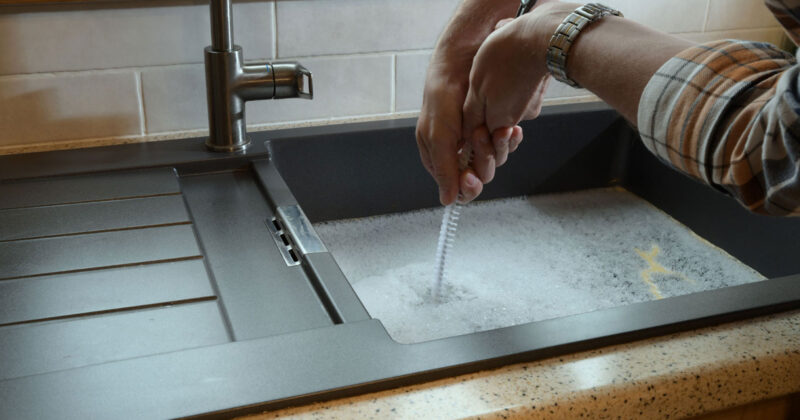
Snaking is the right call when one fixture is clogged and the rest of the house drains fine. A bathroom sink full of hair, a shower that backs up or a toilet with too much paper in it clears quickly with a properly sized cable. Paying for a jetter there means paying for more machine than the job needs.
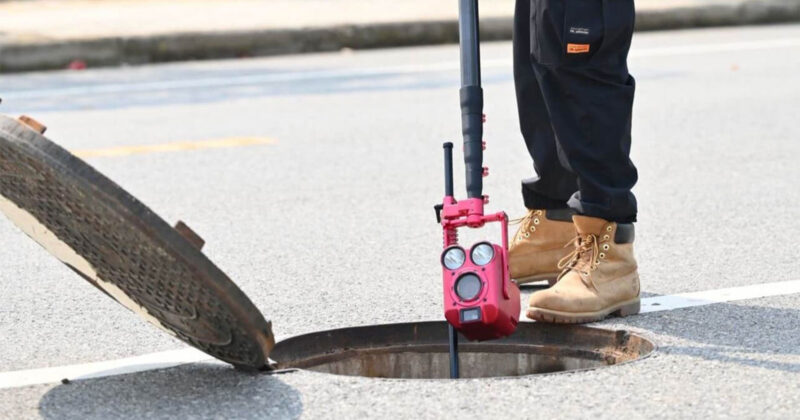
It’s also a sensible first step when a main line has backed up into the house. Getting the water moving lets the family use the bathroom again and gives us an open path to run a camera.
But a snake has a limit. If the same drain clogs again within a few months, the cable is opening the same hole in the same buildup every time, and you’re paying for it every time.
If a drain has been snaked twice in a year, ask for a camera inspection before the third time. The video usually settles whether you need a jetter, a repair or just a different habit at the sink.
When Hydro Jetting Is the Real Fix
Hydro jetting is the real fix when the problem coats the pipe instead of sitting in one spot. Three causes account for most of it in LA County.
- Grease in kitchen lines. Grease goes down warm and sets as it cools, then catches food scraps. Los Angeles County’s grease program names fats, oils and grease building up in sewer lines as a cause of blockages and sewage overflows. A cable pokes a hole through that coating, and the rest stays on the wall.
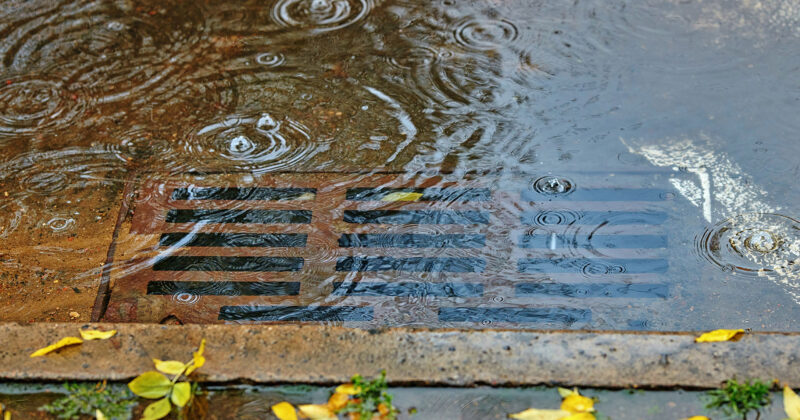
- Roots in clay laterals. Roots get in at the joints and spread into fine hair that a cutter trims but can’t clear. They’re behind a lot of sewer backups after the first rain, too.
- Scale in cast iron. Old cast-iron drains grow rough scale that narrows the pipe and snags everything that passes. Jetting with the right nozzle knocks it down.
LA’s older housing has all three. In older Burbank homes, cast-iron drains inside the house and clay laterals under tree-lined streets are still common. In Huntington Park, plenty of houses built for one family now have two or three kitchens draining into a lateral from the 1920s, and grease is the usual reason it backs up. Restaurants downtown fight the same grease on a bigger scale.
And if you’ve had a kitchen drain clog after a holiday meal, you’ve already seen the grease version up close.
When Jetting Can Do Damage
Jetting can damage a pipe that’s already failing, which is why we run a camera before we jet an old main line. High-pressure water is easy on a sound pipe and hard on a broken one. If a clay joint has separated, a cast-iron section has rusted thin or the pipe has cracked, the water can open the damage further and make a bad section worse.
Orangeburg is the one to watch for. It’s a tar-impregnated fiber pipe used in some homes built from the late 1940s to around 1970, and it flattens as it ages. The City of Ann Arbor’s building department notes that a cutting snake can damage fiber pipe, that jetting alone rarely works once the pipe has lost its round shape, and that replacement is often the only option that holds. If the camera shows Orangeburg, we tell you before any machine goes in.
The same goes for any line the camera shows is broken. Jetting a cracked pipe just cleans it until the next clog.
What You Can Check Today
You can learn a lot about which tool you need before anyone shows up.
- Count the slow drains. One slow fixture points to that fixture’s line. Several at once, or a toilet that gurgles when the washer drains, points to the main line.
- Find your clean-out. It’s a capped pipe, usually near the foundation or along the path to the street. Knowing where it is saves time on the call. Don’t open it while the line is backed up, because everything behind the clog will come out.
- Write down past clogs. Rough dates of earlier snaking jobs tell a plumber whether the cable is keeping up.
- Skip chemical drain cleaner. It rarely clears grease or roots, it’s hard on old pipe, and it can burn whoever opens the line next.
Leave the machines to a plumber. A rented sewer machine on a root-filled clay line can get its cable stuck or break a joint, and LA Sanitation’s own guidance says property owners need a licensed plumber to clear roots from a private line.
When to Call a Plumber
Call when more than one drain is slow at once, when water comes up in a tub, shower or floor drain, when the same drain needs clearing more than twice a year, or when you smell sewage in the yard. If sewage is coming up, stop running water in the house and keep kids and pets away from it until the line is cleared.
On a call like that, we run the camera and show you the video, clearing a path first if the blockage is in the way. Whether jetting is worth it depends on two things, the pipe and the cause. A sound pipe with grease or roots is where jetting earns its cost. A broken pipe needs a repair, and we’ll say so plainly.
If you’re tired of clearing the same drain, Hard Hat Rooter can camera the line and tell you which tool it needs, with a flat-rate price before any work starts. Call (855) 331-7788 any time, day or night, and check our current coupons first.